1. The Problem with Monolithic Synchronous HTTP in High-Load Systems
Modern web architectures handling hundreds of thousands of concurrent requests rapidly exhaust database connection pools and PHP-FPM worker pools when downstream dependencies communicate via synchronous HTTP. In high-concurrency environments (e.g., e-commerce flash sales, payment webhooks, telematics streaming), coupling microservices synchronously introduces cascaded latency degradation, thread pool starvation, and single points of failure (SPOF).
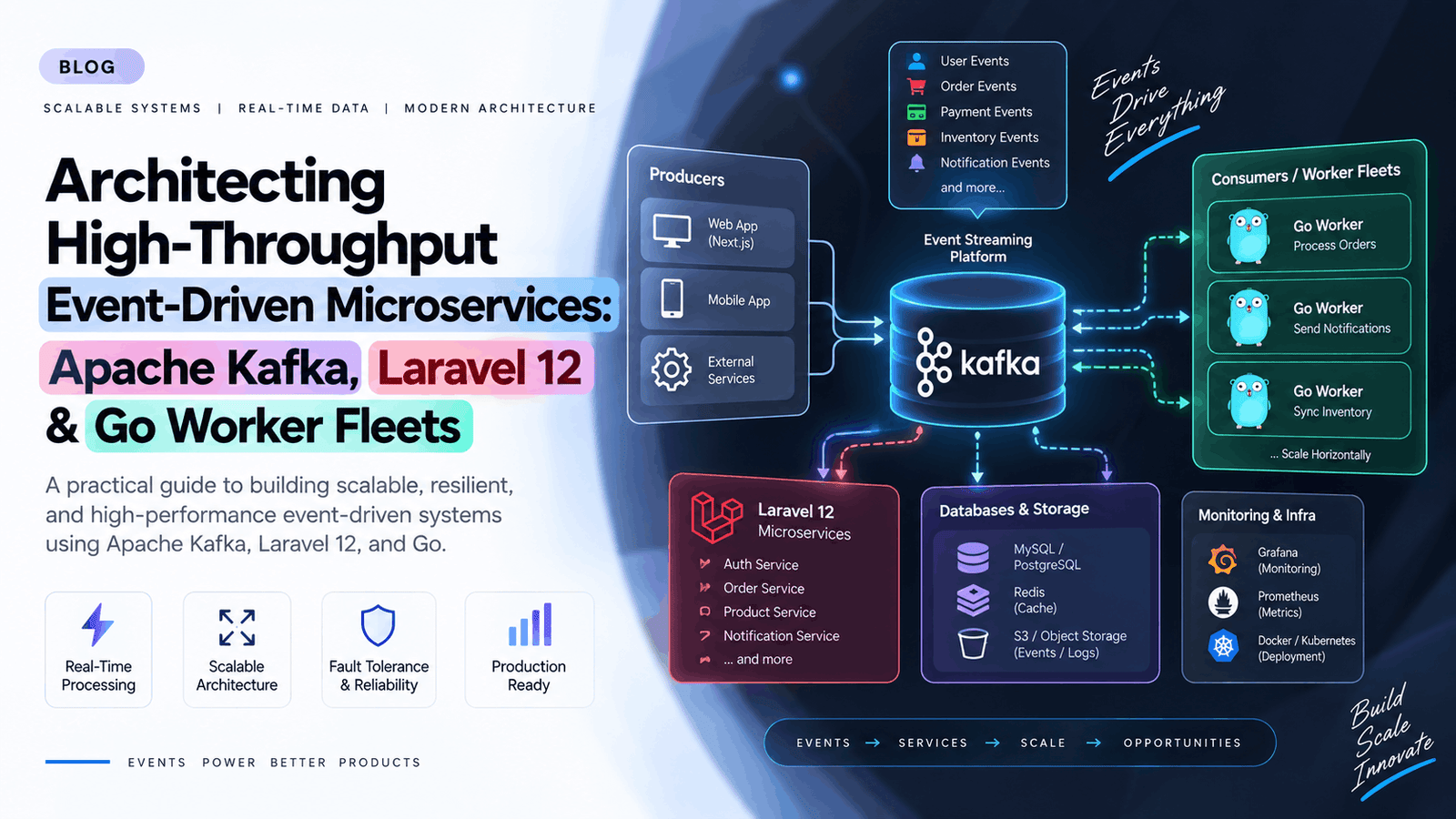
At Techifiles Technologies, we build enterprise backends on event-driven architectures (EDA). By decoupling state transitions into immutable, append-only event streams powered by Apache Kafka, producers emit domain events in single-digit milliseconds, while consumer worker fleets independently process, fan-out, and materialize views asynchronously.
2. Core Architectural Topology: Laravel 12 Producer + Go Consumer Fleet
The optimal enterprise division of labor combines developer velocity with raw concurrent throughput:
- Laravel 12 API / Core Domain: Acts as the transactional master. Expresses complex domain logic, enforces authorization policies, generates structured DTOs, and writes to both MySQL/PostgreSQL and the Kafka topic via the Transactional Outbox Pattern.
- Apache Kafka Cluster (KRaft Mode): Serves as the distributed commit log. Topics are partitioned by entity ID (e.g.,
tenant_idoraccount_uuid) to guarantee total in-order event sequencing within partitions while scaling horizontally across broker nodes. - Go Worker Fleets: High-concurrency consumer daemon processes utilizing
confluent-kafka-goorsegmentio/kafka-gowith native goroutines. Consumes thousands of events per second with sub-10MB memory footprints.
3. The Transactional Outbox Pattern: Eliminating Dual-Write Failures
A fatal anti-pattern in distributed architectures is the Dual Write: committing a transaction in the database and immediately publishing directly to Kafka inside the HTTP request lifecycle. If Kafka is temporarily unreachable or network partitions occur after the SQL commit, state becomes irrecoverably desynchronized.
To eliminate this failure mode, we implement the Transactional Outbox Pattern in Laravel 12:
// App/Services/Order/OrderService.php
namespace App\Services\Order;

use App\Models\Order;
use App\Models\OutboxEvent;
use App\DTOs\OrderCreatedDTO;
use Illuminate\Support\Facades\DB;
use Illuminate\Support\Str;

class OrderService
{
    public function createOrder(OrderCreatedDTO $dto): Order
    {
        return DB::transaction(function () use ($dto) {
            // 1. Primary entity state persistence
            $order = Order::create([
                'uuid'       => Str::uuid(),
                'user_id'    => $dto->userId,
                'amount'     => $dto->amount,
                'status'     => 'pending',
                'metadata'   => $dto->metadata,
            ]);

            // 2. Outbox event committed atomically in the same ACID transaction
            OutboxEvent::create([
                'event_id'   => Str::uuid(),
                'topic'      => 'orders.v1.created',
                'partition_key' => $order->user_id,
                'payload'    => [
                    'order_id' => $order->id,
                    'uuid'     => $order->uuid,
                    'user_id'  => $order->user_id,
                    'amount'   => $order->amount,
                    'occurred_at' => now()->toIso8601String(),
                ],
                'status'     => 'pending',
            ]);

            return $order;
        });
    }
}
4. Ultra-Fast Go Consumer Loop with Goroutine Worker Pools
Go provides unmatched throughput and low latency for consuming from distributed commit logs. Below is our production Kafka consumer worker implementation handling batch ingest:
// worker/main.go
package main

import (
    "context"
    "fmt"
    "log"
    "os"
    "os/signal"
    "syscall"
    "github.com/segmentio/kafka-go"
)

func main() {
    reader := kafka.NewReader(kafka.ReaderConfig{
        Brokers:  []string{"kafka-broker-1:9092", "kafka-broker-2:9092"},
        GroupID:  "order-billing-fleet",
        Topic:    "orders.v1.created",
        MinBytes: 10e3, // 10KB
        MaxBytes: 10e6, // 10MB
    })
    defer reader.Close()

    ctx, cancel := context.WithCancel(context.Background())
    sigchan := make(chan os.Signal, 1)
    signal.Notify(sigchan, syscall.SIGINT, syscall.SIGTERM)

    go func() {
        <-sigchan
        cancel()
    }()

    log.Println("Go Worker Fleet listening on orders.v1.created...")
    for {
        m, err := reader.ReadMessage(ctx)
        if err != nil {
            break
        }
        go processEvent(m.Key, m.Value)
    }
}

func processEvent(key []byte, payload []byte) {
    // Process business analytics, billing token authorization, and cache warming
    fmt.Printf("Processed Event: Partition Key=%s\n", string(key))
}
5. Dead Letter Queues (DLQ) & Idempotency Safeguards
In distributed streaming architectures, network drops or third-party API downtimes will inevitably cause intermittent consumer failures. A robust system requires:
- Idempotent Processing: Every message contains a globally unique
event_id. Consumers check Redis or PostgreSQL unique constraint tables before execution to ensure duplicate messages are safely acknowledged without re-executing transactions. - Exponential Backoff Retries: Transient failures (e.g., rate limits) retry 3 times with jittered exponential backoff.
- Dead Letter Queue (DLQ): If an event fails after maximum retry attempts, it is routed to an isolated dead-letter topic (e.g.,
orders.v1.created.dlq) alerting engineering via PagerDuty without blocking partition ingestion.